May 28, 2026
UPDATE
Cherokee language students bridge generations with iPad and Mac
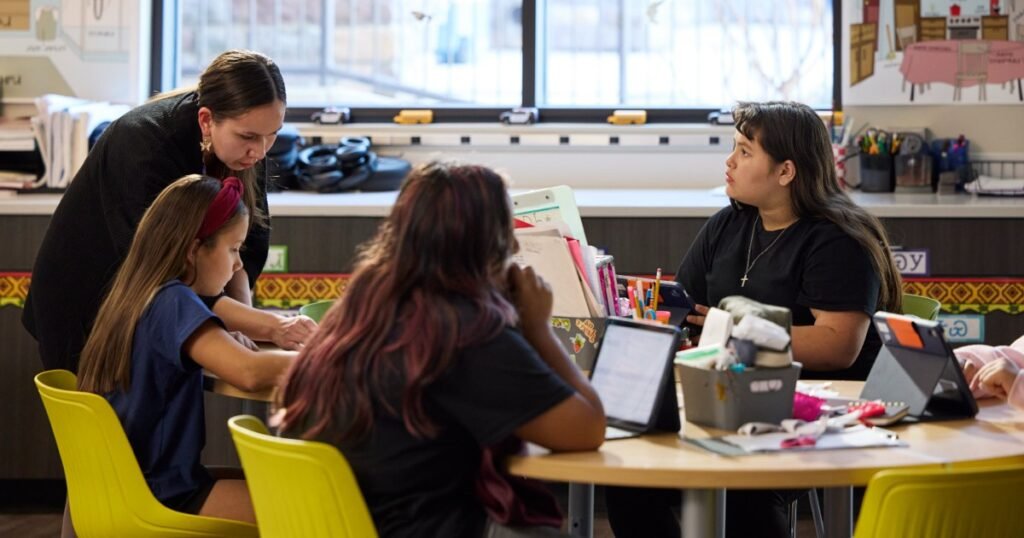
At Cherokee Immersion School in Tahlequah, Oklahoma, the hallways bustle with young students traveling from one classroom to another. The immersion school, a division of the Durbin Feeling Language Center, serves students in kindergarten through eighth grade and is tasked with creating the next generation of Cherokee language speakers.
“They are real language warriors,” said Erlinda “Daksi” Soap, a fifth-grade teacher at the immersion school. “Our mission here at Cherokee Nation and the Durbin Feeling Language Center is to find our future Cherokee leaders, those who are willing to share the language and continue to grow the language.”
Today there are fewer than 1,500 fluent speakers out of a population of over 480,000 Cherokee people around the world. Apple supports the Cherokee Nation – and their partners at Oklahoma City University (OCU) – in their efforts to revitalize the language and culture. Through the Community Education Initiative, Apple is helping equip teachers and young students with iPad and Mac at Cherokee Immersion School and nearby Sequoyah High School.
“The technology we use at Apple has allowed us to take everything we’re really trying to accomplish here, which is the perpetuation and revitalization of the Cherokee language and culture, and use that same technology to make it relevant to the young people who are learning here,” said Chuck Hoskin Jr., Chief of Cherokee Nation.
Teachers like Soap, Tyler Teague, Jennie Pruitt and others have also been selected as technology ambassadors through the initiative. They are undergoing training led by Apple and OCU to explore ways to combine creativity and coding into their curriculum so they can be more effective in reaching younger generations.
In Soap’s classroom, an affirmation mirror sets the tone for the day, with Cherokee phrases like “I am smart, I am loved, and I am strong” greeting each student who stands in front of it. The students are practicing for an upcoming Cherokee Language Challenge Bowl.
“First they wrote words on paper themselves with a pencil, but now they can record themselves and study those words at school and at home,” says Soap.
By recording themselves reciting vocabulary on the iPad, students can practice pronunciation with more confidence. “In the Cherokee language, every sound is so important,” Soap says. ‘One sound out, and you say a completely different word.’
Down the hall, Teague’s class is putting the finishing touches on an animated storytelling assignment. After illustrating their stories in Keynote on the iPad, students use iMovie to record themselves telling their stories. Storytelling is an important part of how language and culture are passed on from generation to generation. Traditions rooted in nature are another essential part of Cherokee culture. To understand the potential uses of plants, including their medicinal properties, students are working to build an app that helps identify and document different species. They create a concept for the app project in Keynote. They then collect images from their environment and annotate them to build a custom machine learning model. Finally, they’ll bring it all together into one app using Apple’s Swift Playground.
“Keynote was really helpful because they could include the name of the plant and a photo of the plant, and they could also record their audio clips so they could say the word themselves,” Teague explains. “So when I say it a certain way in my classroom, and they say, ‘Oh, that’s not what my grandma said,’ I say, ‘Well, write down what your grandma said, because your grandma knows it.’ There is differentiation in our language because tones are very important in the way people say things within different communities.”
“The fact that we can type on the iPad in the Cherokee language and use the syllabary is something that helps us promote literacy,” he says.
“iPad is an amazing tool, and I think it has been revolutionary for everyone who uses it,” says Hoskin. “It really takes everything we’ve built here and puts it all within the reach of a young Cherokee.”
A new immersion program has been established at Sequoyah High School for students graduating from Cherokee Immersion School. Sophomore Olivia Daugherty graduated from the immersion school in 2024 and has continued her language and culture studies in Pruitt’s class.
“I was worried about my language and culture, and about how I might lose my community and my language,” Daugherty remembers. “But what I really liked about Sequoyah was the way they offered Cherokee classes, and that’s when I was introduced to Cherokee.”
Daugherty remembers learning bits and pieces of the language and how to weave as a child. “When we would go cruising, my dad would teach me how to count in Cherokee, and we would just go through it. And he especially taught me how to say animals,” she says. “Then they immersed me with my sister, and I’ve been trying to be inclusive with the language ever since.”
In today’s Conversational Cherokee lesson, Daugherty practices basket weaving with elders. “I use art as an outlet to express my language and culture,” says Daugherty.
“It all starts with our origin story, the first fire,” Pruitt explains of the first lesson in her weaving class. “We needed fire. There were different animals sent out in the story, and it ends up being the water spider that goes and gets the flame and brings it back. And she can do that by weaving a basket.”
For Daugherty, the practice is another reminder of her childhood, learning weaving and pottery from older women who shared their stories with her. “It’s more like sharing memories than anything else,” Daugherty says.
Once the origin stories are shared, Pruitt has her students tour the school and their homes to photograph baskets with their iPad devices. The photos are then used as a reference for students to design their own baskets in Freeform on iPad.
“Having the iPad provides opportunities for video and audio recording, teaching the kids podcasting skills and teaching the students Keynote to write reports,” Pruitt says. “It’s really useful to have access to our language, our Cherokee font on iPad, and to add text to our videos and audio.”
In the STREAM (science, technology, research, engineering, art, and math) Lab, ribbon skirts hang on clothing racks next to Mac computers, large format printers, and sewing machines. Students use iPad and Apple Pencil to design their own skirts before sewing them by hand. The lab also serves as a studio for the student-run podcast, Stories of Sequoja. Teacher Melissa Fourkiller assists a group of students as they conduct an interview with Sam Horsechief, an elder in the community who has coached at the school since 1987. They are recording and editing the audio for an upcoming episode.
“The STREAM classroom brings together sewing, storytelling and digital media,” says Fourkiller. “Students create traditional objects while learning the cultural meaning behind them, and they use Apple tools like GarageBand on Mac computers to create podcasts that respectfully preserve and share Cherokee stories. Through these projects, they develop creativity, collaboration and problem-solving skills while learning to use technology with purpose.”
“Without Apple products and the things we do today, we wouldn’t see the language evolve as quickly as it has,” said Bryan Warner, deputy chief of the Cherokee Nation and also a former teacher.
Throughout their history, stories and technology have been a common thread for the Cherokee. The written syllabary was founded more than 200 years ago by a Cherokee warrior named Sequoyah and was a revolutionary tool that allowed the language to be documented and communicated in writing for the first time. Sequoyah established 86 characters to represent the sounds (or syllables) in spoken language. This paved the way for the country’s first bilingual print newspaper, and more recently, the keyboards on students’ Mac, iPad and iPhone devices.
“A big part of being Cherokee is making sure things like language and culture survive and continue to exist,” says Roy Boney Jr., a Cherokee artist who worked with Apple engineers to bring the syllabary to Mac, iPad and iPhone. “In previous generations it was just passed on naturally.”
“Having the syllabary on the iPhone or on a Mac laptop really takes us back in time,” Hoskin says. “It seemed like something that was in the history books. Now suddenly it’s at the forefront of technology on our phones. I think that’s real power.”
That power is already in the hands of language warriors like Daugherty.
“My niece, she is a first language speaker of our language,” Daugherty says. “She is one of the first in a very long time.”
Press Contacts
David Tremblay
Apple
(647) 943-4673
Cortney Hughes
Apple
(647) 943-4562